In a young, very informal company, the design department was run by an artist. The term 'design department' was not accurate in this case; it was more a group of designers who were working together. In addition, everyone was much too busy, including the head of the department.
One project involved producing a number of designs, which were quite important to the success of the project. A young designer on the project team created the designs. Although the head of the design department had ultimate responsibility for the designs, he never attended the meetings of the project team when the designs were to be discussed. The project leader always invited him, and sent him e-mails containing his young colleague's sketches, but the e-mails remained unanswered. The project leader and the young designer erroneously assumed that the department head had approved the designs. The implementation phase began. When the project was nearly finished, the result was presented to the department head, who became furious and demanded that it be completely redone. The budget, however, was almost exhausted.Monday, March 16, 2015
Project Management - Design phase
Project Management - Definition phase
It is important to identify the requirements as early in the process as possible. Wijnen (2004) distinguishes several categories of project requirements that can serve as a memory aid:
· Preconditions
· Functional requirements
· Operational requirements
· Design limitations
Preconditions form the context within which the project must be conducted. Examples include legislation, working-condition regulations and approval requirements. These requirements cannot be influenced from within the project. Functional requirements are requirements that have to do with the quality of the project result (e.g. how energy-efficient must an automobile be or how many rooms must a new building have?). Operational requirements involve the use of the project result. For example, after a software project has been realised, the number of malfunctions that occur must be reduced by ninety per cent. Finally, design limitations are requirements that involve the actual realisation of the project. For example, the project cannot involve the use of toxic materials or international partners for whom it is unclear whether they use child labour.
During the definition phase of a project that involved developing a web application for a consortium of large organisations, no agreements were made concerning the browser that would be supported by the application. The consortium assumed that it would be Microsoft Explorer, because it was the browser that 'everyone' used. The programmers created the application in Firefox, because they worked with the browser themselves and because it had a number of functions that were particularly useful during the development. Because most of the websites that are made for Firefox also look good in Explorer, the difference was initially not noticeable. Near the end of the project, however, the customer began to complain that the website 'didn't look good'. The programmers, who had been opening the site in Firefox, did not understand the complaint.
When the problem of the two browsers became clear, the programmers reacted defensively, 'Can't they just install Firefox? After all, it is free'. The organisations, however, were bound to the bureaucratic-minded system administrators who, for some possibly justified reason, refused to install Firefox in addition to Explorer. Even if they had wanted to install it, it would have involved a lengthy process, and there would have been extra costs for the time that the system administrators would have to spend on the task. It was ultimately decided that the application would have to be made suitable for Explorer. That involved considerable extra work, whereby the project ran even more behind schedule than it already had, and it was necessary to negotiate the extra costs. It was later discovered that the various organisations were working with different versions of Microsoft Explorer.
It is very important that all parties that are involved in the project are able to collaborate during the definition phase, particularly the end users who will be using the project result. The fact that end users are often not the ones that order the project perhaps explains why they are often ignored. The client, who pays for the project, is indeed invited to collaborate on the requirements during the definition phase. Nonetheless, the project result benefits when its future users are also invited. As a point of departure, it is helpful to make a habit of organising meetings with all concerned parties during the definition phase of a project.
During the development of an educational video game, the users (young people) were involved in the project only at a later stage. When the game was nearly completed, a group of young people was asked to test the game. Their initial assessments appeared mild and friendly. When pressed, however, they admitted that they had actually found the game 'extremely boring' and that they would 'certainly not play it themselves'. Had these young people been involved in the project earlier, the game would probably have been a success. As it stands, the game remains nearly unused on an Internet website.
The result of the definition phase is a list of requirements from the various parties who are involved in the project. Every requirement obviously has a reverse side. The more elaborate the project becomes, the more time and money it will cost. In addition, some requirements may conflict with others. New copy machines are supposed to have less environmental impact; they must also meet requirements for fire safety. The fire-safety regulations require the use of flame-retardant materials, which are less environmentally friendly. As this illustration shows, some requirements must be negotiated.
Ultimately, a list of definitive requirements is developed and presented for the approval of the project's decision-makers. Once the list has been approved, the design phase can begin. At the close of the definition phase, most of the agreements between the customer and the project team have been established. The list of requirements specifies the guidelines that the project must adhere to. The project team is evaluated according to this list. After the definition phase, therefore, the customer can add no new requirements.
A part of a new exhibit in a museum was comprised of a computer installation, the creation of which had been project-based. Because there had been no definition phase in the project, no clear agreements between the museum and those responsible for building the installation had been made. When the computer for the installation broke down halfway through the exhibit, the museum assumed that it would be covered by the project's guarantee. The project team had a different opinion. Negotiations between the directors were necessary in order to arrive at an appropriate solution.
Project Management - Initiation phase
The initiation phase is the beginning of the project. In this phase, the idea for the project is explored and elaborated. The goal of this phase is to examine the feasibility of the project. In addition, decisions are made concerning who is to carry out the project, which party (or parties) will be involved and whether the project has an adequate base of support among those who are involved.
In this phase, the current or prospective project leader writes a proposal, which contains a description of the above-mentioned matters. Examples of this type of project proposal include business plans and grant applications. The prospective sponsors of the project evaluate the proposal and, upon approval, provide the necessary financing. The project officially begins at the time of approval. Questions to be answered in the initiation phase include the following:
· Why this project?
· Is it feasible?
· Who are possible partners in this project?
· What should the results be?
· What are the boundaries of this project (what is outside the scope of the project)?
The ability to say 'no' is an important quality in a project leader. Projects tend to expand once people have become excited about them. The underlying thought is, 'While we're at it, we might as well …' Projects to which people keep adding objectives and projects that keep expanding are nearly certain to go off schedule, and they are unlikely to achieve their original goals.
In the initiation phase, the project partners enter a (temporary) relationship with each other. To prevent the development of false expectations concerning the results of the project, it makes sense to explicitly agree on the type of project that is being started:
· a research and development project;
· a project that will deliver a prototype or 'proof of concept';
· a project that will deliver a working product.
The choice for a particular type of project largely determines its results. For example, a research and development project delivers a report that examines the technological feasibility of an application. A project in which a prototype is developed delivers all of the functionalities of an application, but they need not be suitable for use in a particular context (e.g. by hundreds of users). A project that delivers a working product must also consider matters of maintenance, instructions and the operational management of the application.
Many misunderstandings and conflicts arise because the parties that are involved in a project are not clear on these matters. Customers may expect a working product, while the members of the project team think they are developing a prototype. A sponsor may think that the project will produce a working piece of software, while the members of the project team must first examine whether the idea itself is technically feasible.
What is Project Management?
More specifically, what is a project? It's a temporary group activity designed to produce a unique product, service or result.
A project is a one-time effort that produces a specific result, for example, a building or a major new computer system. This is in contrast to a program, which is 1) an ongoing process, such as a quality control program, or 2) an activity to manage a series of multiple projects together. In some countries, the term "program" refers to a software tool and the term "programme" can mean a TV or radio show.
A project is temporary in that it has a defined beginning and end in time, and therefore defined scope and resources.
And a project is unique in that it is not a routine operation, but a specific set of operations designed to accomplish a singular goal. So a project team often includes people who don't usually work together – sometimes from different organizations and across multiple geographies.
The development of software for an improved business process, the construction of a building or bridge, the relief effort after a natural disaster, the expansion of sales into a new geographic market — all are projects.
And all must be expertly managed to deliver the on-time, on-budget results, learning and integration that organizations need.
Project management, then, is the application of knowledge, skills and techniques to execute projects effectively and efficiently. It's a strategic competency for organizations, enabling them to tie project results to business goals — and thus, better compete in their markets.
Project management is a carefully planned and organized effort to accomplish a successful project. Project management includes developing a project plan, which includes defining and confirming the project goals and objectives, identifying tasks and how goals will be achieved, quantifying the resources needed, and determining budgets and timelines for completion. It also includes managing the implementation of the project plan, along with operating regular 'controls' to ensure that there is accurate and objective information on 'performance' relative to the plan, and the mechanisms to implement recovery actions where necessary.
Projects usually follow major phases or stages (with various titles for these), including feasibility, definition, project planning, implementation, evaluation and support/maintenance.
It has always been practiced informally, but began to emerge as a distinct profession in the mid-20th century. PMI's A Guide to the Project Management Body of Knowledge (PMBOK® Guide) identifies its recurring elements:
Project management processes fall into five groups:
- Initiating
- Planning
- Executing
- Monitoring and Controlling
- Closing
Project management knowledge draws on ten areas:
| Integration | Scope | Time |
| Cost | Quality | Procurement |
| Human resources | Communications | Risk management |
| Stakeholder management |
All management is concerned with these, of course. But project management brings a unique focus shaped by the goals, resources and schedule of each project. The value of that focus is proved by the rapid, worldwide growth of project management:
- as a recognized and strategic organizational competence
- as a subject for training and education
- as a career path
5 Tips For Better Task Lists
1 - Work with your team
List out the tasks you can think of, then ask your project team to sit down and brainstorm additional items for the project plan. Undoubtedly, they'll flag some tasks you hadn't considered. At this stage of the game, stay focused on recording everything - either on paper or in your project software - not allocating resources. Get the details down right, then get the team back together later to get the right tasks to the right people.
2 - Add structure to your list
Once your list is complete, it's time to get organized. If you haven't already, add the tasks to your project software, then start putting them in logical groups. Add some subheadings to make everything easier to navigate, and to keep related tasks together. Building this structure in now will make it easier to find individual tasks later, and streamline task assignments and reporting.
3 - Set your task priorities
Some tasks will always be a higher priority, so make sure the most important project tasks are easy to find. Use your task management tools to highlight the most important tasks, perhaps by using a different color, making the font bold or adding some stars next to those items. You'll instantly be able to see your priorities for the day.
4 - Store everything in one place
Scattered task lists make it hard to stay on top of priorities – or plans. Count on your project software to keep all your tasks in one centralized location. The task management features in tools make it easy to keep all your tasks in order, and share them with the rest of the team.
5 - Check off completed tasks
The best thing about task lists: checking off what's completed. There are few things more satisfying than marking a task complete or ticking off a to-do list checkbox. Even better, when you're using web-based project software, everyone else on the team can celebrate those ticked-off checkboxes with you, in real time!
Make creating and managing project task lists easy with a great project tools. You can import your existing task lists from other tools, create new lists on the fly and share your tasks with your project team in real time.
Project Implementation
Executive Summary
Implementation simply means carrying out the activities described in your work plan. Executing a project in the water and sanitation sector is a very complex mission, as it requires the coordination of a wide range of activities, the overseeing of a team, the management of budget, the communication to the public, among other issues. Independent of whether it is a social project to raise the awareness and promote hygiene or it is a construction project for service delivery, there is a certain process that has to be followed. The following lines will give you an introduction into the implementation of projects in sustainable sanitation and water management, and highlights key aspects that have to be taken into account for a successful implementation
Project implementation (or project execution) is the phase where visions and plans become reality. This is the logical conclusion, after evaluating, deciding, visioning, planning, applying for funds and finding the financial resources of a project.
The implementation of projects in sustainable sanitation and water management is complex. It requires the coordination of a wide range of activities, diverse institutional arrangements, and different time frames (DFID 1998). There is not one typical project in water and sanitation, as the actions may vary from the construction of a new infrastructure, to the introduction of new ways of working. Projects in this area cover issues such as: social development, health, environmental sustainability, institutional strengthening, technical implementation, pilot plants, service delivery, social marketing, hygiene promotion, sanitation promotion and capacity building.
It is important to take into account that independently of the nature of the project, implementation takes time, usually more than it is planned, and that many external constraints can appear, which should be considered when initiating the implementation step (i.e. seasonality in availability of community engagement/resources) (NETSSAF 2008).
Objectives of the Implementation Phase
The objectives of the implementation phase can be summarised as follow:
- Putting the action plan into operation (PHILIP et al. 2008).
- Achieving tangible change and improvements (PHILIP et al. 2008).
- Ensuring that new infrastructure, new institutions and new resources are sustainable in every aspect (MORIARTY et al. 2007).
- Ensuring that any unforeseen conflicts that might arise during this stage are resolved (MORIARTY et al. 2007).
- Ensuring transparency with regard to finances (MORIARTY et al. 2007).
- Ensuring that potential benefits are not captured by elites at the expenses of poorer social groups (MORIARTY et al. 2007).
How to Get Started
Before implementing the action plan, it is important to ensure that all the roles and responsibilities are distributed and understood. Source: WSP (2009)
"The basic requirement for starting the implementation process is to have the work plan ready and understood by all the actors involved. Technical and non-technical requirements have to be clearly defined and the financial, technical and institutional frameworks of the specific project have to be prepared considering the local conditions. The working team should identify their strengths and weaknesses (internal forces), opportunities and threats (external forces). The strengths and opportunities are positive forces that should be exploited to efficiently implement a project. The weaknesses and threats are hindrances that can hamper project implementation. The implementers should ensure that they devise means of overcoming them. Another basic requirement is that the financial, material and human resources are fully available for the implementation" (NETSSAF 2008). Other actions need to be taken before work can begin to implement the detailed action plan, including:
- Scheduling activities and identifying potential bottlenecks.
- Communicating with the members of the team and ensuring all the roles and responsibilities are distributed and understood.
- Providing for project management tools to coordinate the process.
- Ensuring that the financial resources are available and distributed accordingly.
Tips for Implementing Successful Projects
(Adapted from PHILIP et al. 2008)
- Field management staff must make time to establish an atmosphere of candour and trust with partners during implementation so that concerns may be raised (and often resolved) informally.
- Realistic long-term planning of finances is key to the implementation of an action plan (see also financing and sources of funding).
- A communication strategy can be used to raise awareness of the positive benefits for the community, as well as explaining that there are necessary trade-offs, such as the introduction of water pricing, which will not please everybody. This will help to further strengthen local ownership of the plan and encourage public participation in the implementation of projects.
- At the end of a planning and implementation cycle, a press release is useful to highlight successful stories and announce the publication of a final document such as a water report (see also media campaigns).
- Expectations among stakeholders and the general public are likely to be high following the participatory approach to the development of the preceding stages of the planning process. It is therefore important that actions are visible and demonstrate tangible results early to build confidence in the process.
Implementation of Engineering Projects and Service Delivery
The detailed design, tendering, and construction of the infrastructure will take place during this step. Depending on the situation and the complexity, the project might be implemented through a formal construction contract or a voluntary community approach.
Formal written contracts are required where external contractors undertake specialist construction or installation work. This work should be awarded through a competitive tender process to ensure value for money (DFID 1998). "Other procurement strategies could be a design and build scheme, and a build, own, operate and transfer conception (BOOT). When formal contracts are used, there is the risk of leaving out the social framework and the needs of the users. Therefore, it is necessary to integrate the community during the implementation step, in order to create ownership of the new infrastructure" (NETSSAF 2008).
In community-managed projects, the members of the community are involved in the construction and installation of the new infrastructure through voluntary labour agreements, in-kind contribution, food for work schemes, and self-help programmes where the communities are provided training and resources to carry out the work themselves (NETSSAF 2008). It is generally more cost-effective to use labour from within the community as much as possible. However, there has to be some guarantee of quality and an understanding of the scope of the work. It is useful to have a written agreement between the primary and secondary stakeholders (community and government) defining roles and responsibilities and also agreeing the scope of the works. This will avoid confusion or disagreement later on in the project (DFID 1998).
"It is important to take into account that in urban or peri-urban areas many people already earn a living and would not be prepared to contribute labour to a water supply or sanitation scheme but would rather contribute cash. This situation needs to be assessed at the early stages of a project" (DFID 1998).
A strategy for capacity development should be prepared in order to ensure an effective construction, operation and maintenance work. Training activities will target technicians, masons, users, and other service providers. These activities aim at building the required capacities for the implementation and can be carried out through workshops, specialised training courses, "learning by doing" approach, amongst others.
Whatever method is selected, the construction and installation activities must be carried out under the supervision of experts and engineers. "The level of supervision required will naturally depend on the complexity of the construction work. However, if the design includes any engineering specification, then qualified staff should be available on a full-time basis to oversee construction of the works. The quality of work will suffer if supervision is inadequate because corners may be cut, inferior materials used, and safety compromised" (DFID 1998). The involvement of the designers is also needed during the construction stage, particularly to answer questions and make changes in the design when improvements and adaptations are required.
A practical implementation plan should be prepared by the implementation team to define real time schedule of delivery of services, such as (NETSSAF 2008):
- When the purchase of materials is completed.
- When the excavation is finished.
- When the structures of the buildings are constructed.
- When the commissioning is expected.
Other aspects that have to be taken into account during the construction phase are: sourcing, availability of funds, payment procedures, preparation of contracts, supervision of community labour, division of labour between women and men (see also gender issues, regular meetings with actors, etc.)
"Local practices and skills should be exploited in the design and construction of the infrastructure, for instance, in some countries the quality of concrete work is very poor, while masonry skills are excellent. Similarly, local materials and construction methods should be employed wherever possible. This may not always be possible, for example if rotary drilling in rock is required, but the community should be consulted because they may have their own ideas. In some cases the use of local materials is unacceptable to the partners if it is of a very low quality; it would probably not be cost-effective to purchase local asbestos cement pipes with a design life of five years, if imported ones have a design life of 30 years" (DFID 1998).
Implementation of Social Projects
As mentioned before, social projects are also very common in the water and sanitation field, as they usually target the human factor that is crucial for achieving sustainability of the SSWM measures. These projects are usually related to the change of behaviours and strengthening of capacities by awareness raising campaigns, training activities, institutional set-ups, etc. As these projects cover a wide range of activities that are case-specific, how the implementation will take place will vary from case to case. However, the implementation of a project will always be successful if management strategies and coordination guidelines are clearly defined.
Independent of the type of project to be carried out, a work plan is needed indicating the pursued objectives, the expected results, the activities to be developed, as well as the budget available and timeframe given. Each of the activities has to be assigned to a particular individual, department or organisation that should have proven experience and the capacity to achieve the goals. Local community workers, who can speak the local languages, are the first to integrate in the project, as these types of actions require that the implementers know the culture of the community to gain their trust and achieve a real impact.
It is of primordial importance that the financial resources are readily available at the beginning of the action, so the members of the team have the budget to initiate the activities and cover their own expenses. The management team should look for strategic partnerships with local leaders and spokespersons, giving institutional backup to the actions. Directors and CEOs of the leading organisation should participate in the opening ceremonies or kick-off meeting supporting the local workers, thus facilitating future activities that will be done in the field.
An activity and financial reporting procedure has to be prepared and communicated to the members of the team. It should be clear from the beginning of the action, how all the costs incurred will be reported and reimbursed. It is important to keep procedures as simple as possible, using simple tables and template for reporting costs, field visits, interviews, workshops, meeting minutes, etc.
A controlling strategy has to be developed, in order to monitor the work done on the field. A clearly defined decision making process will set the roles and responsibilities of the members of the team: field worker ->task leaders -> work package leader -> project manager -> coordinator of the project -> steering committee. This ladder will allow for immediate correction of actions and efficient use of (human) resources.
Communication channels should be kept open between the field workers and the management team, making use of mobile phones, SMS, E-mails, etc. It is important to avoid overloading the team with bureaucratic procedures that nobody will follow (like newsletters, long reports, weekly E-mails, etc). Instead, monthly meetings should be planned, bringing the field workers together to report, exchange experiences and learn from each other's successful and failing stories.
Applicability
Implementation is the desired step after the carrying out of a participatory planning process, as it represents the realisation of the plans and activities described in the strategy paper.
Advantages
- Implementation gives the opportunity to see the plans become a reality
- Execution of projects allows end-users to have access to better services and living environment
- Success stories and experiences can be shared with specialists from other cities and towns, encouraging others to adopt similar approaches, which in turn may improve water resources management in the local area
Disadvantages
- Evidence of corrupt practices in procurement will undermine the entire process and waste precious resources (PHILIP et al. 2008)
- Poor financial planning can lead to budget constraints in the midst of implementation
- The decision on when a project is complete often causes friction between implementers and the community. Completion for the implementer is quite straightforward. It is defined by contracts, drawings, and statutes. Communities have a more practical approach to completion. Once the project produces the benefits for which they agreed to undertake it they see no reason to spend further time and money on it (DFID 1998)
Project Management
Executive Summary
All those who have been involved in a project will agree that making a project succeed is not simple. The difficulties are manifold: delays, excessive budget over-runs, inadequate results, dissatisfied end-beneficiaries, high stress among the project team and other undesirable outcomes. Therefore, the purpose of these project management guidelines is to help you to organise, plan and control your projects to make sure you do not encounter these difficulties. Projects are characterised by four features: a group of people, a goal, limited time and money and a certain level of uncertainty regarding whether the goals will be achieved. Project managers are involved with all of these aspects, which makes supervising and directing a project anything but an easy task. Following these lines will help you to maximise the potential for your projects to succeed by helping you address each element of your project at the right time and to the right level of detail for the size and complexity of your project.
In the last decades, projects became increasingly common in the water and sanitation sector. Project-based working methods have found their way into non-profit organisations. "The rules of the game for projects in non-profit organisations differ from those in commercial organisations, because there are political factors that play a particularly important role in the public sector. This makes it even more difficult for projects to succeed, compared to projects in which commercial aspects play a part. Project leaders should be aware of this and be able to play the game of politics" (BAARS 2006).
Definition of Project
A project is a unique venture to produce a set of outputs within clearly specified time, cost and quality constraints. Projects differ from standard business operational activities as they (adapted from METHOD123 2003):
- Are distinctive in nature, not involving a repetitive process.
- Have a define time-plan, with a specified start and end dates to meet the beneficiaries or funding agency's requirements.
- Have an allocated budget, which should be spent to produce the deliverables.
- Have limited resources, such as labour, material and equipment.
- Involve a risk, as there is a level of uncertainty whether the objectives will be attained.
To Be Successful a Project Must
(Adapted from BERR 2007)
Deliver the outcomes and benefits required by the organisation, its delivery partners and other stakeholder organisations.
- Create and implement deliverables that meet agreed requirements.
Meet time targets.
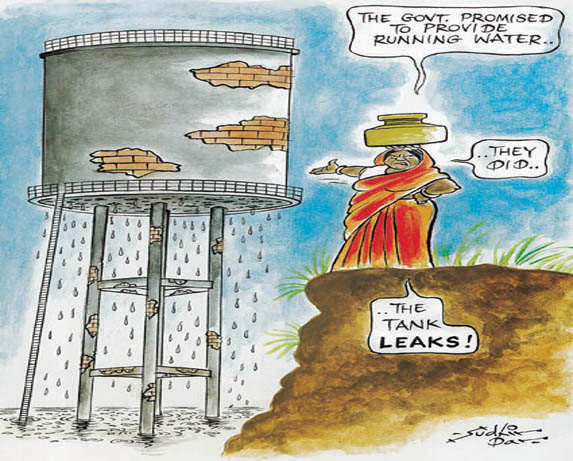
Improper project management is just one of the factors that can cause a major delay in achieving the project goals. Source: WSP (2002)
- Stay within financial budgets.
- Involve all the right people.
- Make best use of resources in the organisation and elsewhere.
- Take account of changes in the way the organisation operates.
- Manage any risks that could jeopardise success.
- Take into account the needs of staff and other stakeholders who will be impacted by the changes brought about by the project.
Definition of Project Management
Project management is a carefully planned effort to accomplish a specific objective, using knowledge, skills, tools, and techniques to plan and implement activities to meet or exceed stakeholder needs and expectations from a project.
The final aim of managing projects in the water and sanitation sector should be to "implement activities identified and planned for in the previous phases in an effective, cost-efficient and high quality way" (MORIARTY et al 2007).
Components of Project Management
(Adapted from BAARS 2006)
Goals should be defined so that they are achievable. Source: WSP (2009)
- Team: A project team is comprised of a group of people who will realise the project result. The group is often comprised of people who have various backgrounds, each of whom contributes knowledge and skills.
- Goal: A product result (or goal) is desired. After a project has been completed, something has been realised. A new treatment system has been implemented, a training course has been carried out or an assessment has been done. In many projects, it is necessary to adapt the goal as the project proceeds.
- Limited resources: The amount of time and money that is available for completing a project is always limited. No project is completely free of time pressure.
- Uncertainty (risk): One characteristic feature of projects is that their success is never guaranteed beforehand. Even if the desired goal is already being reached, it is uncertain whether it will be achieved within the available budget or within the proposed time. It is not unusual for a project to take three times as long and to cost twice as much as originally estimated. It is also not unusual for only thirty per cent of the original project team members to be working on the project upon its completion.
Although project managers must attend to many matters, they actually direct projects along only five parameters:
- Time
- Money
- Quality
- People (organisation)
- Information
These five parameters, which are often known as the "control factors", are described further below. The control factors appear in project plans, progress monitoring and project reporting.
Managing Time
(Adapted from BAARS 2006)
The time factor manifests itself in a project in the form of deadlines for tasks and the amount of time that these tasks may take. Managing time involves ensuring that tasks are completed on time.
Time in project plans:
- Determine which activities should take place in which phase.
- Estimate how long each activity will take.
- Determine the order in which activities should be completed.
- Allocate people and materials.
- Allocate activities over time.
- Determine the (most important) deadlines.
Time in progress monitoring:
- Monitor progress.
- Monitor deadlines.
- Adjust schedules.
Time in project reporting:
- Report on the actual timeline.
- Analyse and explain why some tasks proceeded much more quickly or much more slowly than expected.
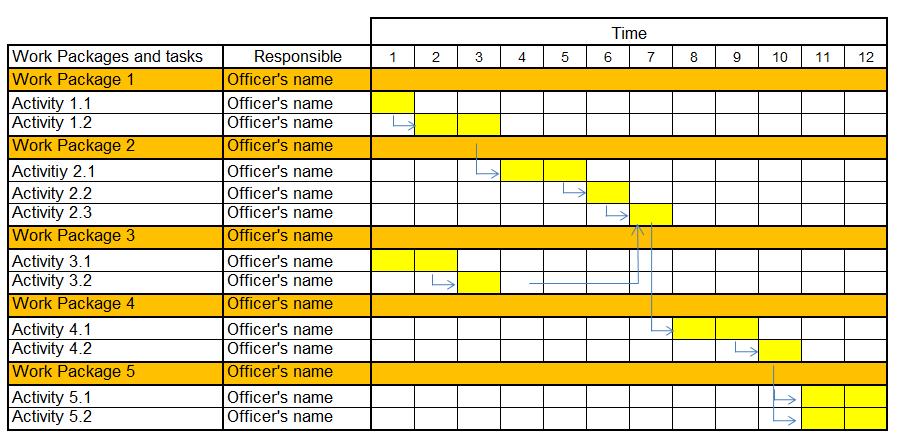
Time schedules are based on a work-breakdown structure (WBS). A WBS is a decomposition of the tasks that must be completed in order to achieve the project result, such as Work Packages or Activity Packages. Developing a time schedule requires knowing the amount of time that is needed for each task, who will complete each task and when. One frequently used tool for planning time is the bar chart or Gantt chart.
Gantt chart or bar chart, which is commonly used for time planning. Source: BARRETO (2010)
The Gantt chart is a specialised bar chart used to provide a graphical overview and schedule of all tasks to indicate the work elements and dependencies of project. This is a chart with rectangular bars. The length of each bar is proportional to the time value necessary for each task on the work breakdown structure. The final product illustrates the schedule of a project (MANAGING PROJECT RISKS 2009).
Managing Money
(Adapted from BAARS 2006)
The money factor manifests itself in the project budget. The management of money within a project involves ensuring that the costs remain within the budget. Given that the majority of the costs in most projects are comprised of labour costs, the factors of money and time (the number of labour hours) are closely intertwined.
Money in project plans:
- Determine the fees of the team members.
- Estimate the hours for the team members.
- Assign budgets to team members for specific tasks.
- Determine costs for material and tools.
Money in progress monitoring:
- Monitor cash flow.
- Negotiate with suppliers.
- Determine whether the original cost estimates are still accurate.
- Adjust budgets.
- Negotiate with customer and/or client concerning budget adjustments.
Money in project reporting:
- Compile financial reports and statements.
- Analyse definitive financial report.
Managing Quality
(Adapted from BAARS 2006)
The project result must fulfil a number of quality requirements. This also applies to the various intermediate products of the project. When managing a project, it is particularly important for quality requirements to be determined, agreed upon and recorded in writing during the definition phase. These requirements should never remain implicit. A clear list of requirements can be checked at the end of the implementation phase. This can allow the project team to prove that they have carried out the project according to specifications. Additional quality requirements may be specified for various tasks within the project. For example, a particular task can be carried out only by certified personnel.
Quality in project plans:
- Establish the desired quality of the project result and the intermediate products.
- Establish the desired quality of the carrying out of the various activities in the project.
Quality in progress monitoring:
- Test the (intermediate) results.
- Address any quality problems.
- Quality in the project reporting:
- Confirm that the desired quality has been attained.
- Address any complaints (particularly in the follow-up phase).
Managing People
(Adapted from BAARS 2006)
Within a project, the team must be managed. In the narrowest sense, team management involves determining who will do what from the list of activities. In broader terms, it also involves all of the soft skills (e.g. motivational techniques, communication skills, leadership styles) that are needed to achieve a goal with a group of people.
Organisation in project plans:
- Assemble the team.
- Assign authority.
- Assign tasks to team members.
- Make agreements concerning the availability of people with other (project) managers and higher management.
Organisation in progress monitoring:
- Direct the team.
- Monitor human aspects (soft skills).
- Mediate between the parties who are involved in the project.
Managing Information
(Adapted from BAARS 2006)
The information factor concerns how, by whom and on which basis decisions can be taken, as well as which tools (e.g. project website, issue tracker, e-mail notification, joint agenda) will be used for communication. These and other informational issues must be answered before a project can be started. Organisations that regularly work with projects have a number of tools (e.g. Word templates) on hand for handling information within a project.
Information in project plans:
- Which information must be provided to whom and in which form?
- Which information will be recorded, distributed and archived?
- Which information tools will be used?
Information in progress monitoring:
- Arrange for periodic consultation.
- Ensure that the right information is provided to the right person.
- Determine whether agreements have been met.
Information in project reporting:
- Write the project report.
Applicability
Any task that requires some preparation to achieve a successful outcome will probably be done better by using a few project management methods somewhere in the process. Project management methods can help in the planning and managing of all sorts of tasks, especially complex activities.
Project management techniques and project planning tools are useful for any tasks in which different outcomes are possible ― where risks of problems and failures exist ― and so require planning and assessing options, and organising activities and resources to deliver a successful result.
Advantages
- A more efficient usage of resources (both human and monetary resources) as both the schedule and the budget are defined in the project plan
- Reduced cost and improved quality of the end product/service delivered by implementing rigorous cost management and quality management processes
- A healthier, more solid relationship with the stakeholders
- An enhanced teamwork environment because of the adoption of a formal process to acknowledging/resolving conflicts (conflict management)
- A favourable touch of professionalism to the company leading to a better perception by outside organisations
Disadvantages
- Project management costs money, which can be defined as an overhead cost. In the case of small organisations to cover the cost of one project manager is a huge overhead
- Project management introduces another layer of communication between management and team members. Instead of having the information flow directly from functional managers down to the team members and back up, it's all funnelled through the project manager
- Instead of just "getting the project done", which is the whole point of project management, some project managers have become so focused and so obsessed about the methodology that the latter has grown to be the "end" rather than the "mean to the end". This jeopardises the delivery of the project and causes missed opportunities as project managers become so closed and so protective their own methodology that they refuse to experiment with another one that might be faster and better for their current project
- Some organisations, when adopting project management, suffer from non-creativity, which can be either technical or managerial. Project management imposes deadlines on staff, which have to work as fast as they can to finish their tasks on time. This may demotivate the staff and adversely affects the quality of the end product
References
BAARS, W. (2006): Project Management Handbook, Version 1.1 – July 2006. URL [Accessed: 17.04.2012]. PDF
BERR- DEPARTMENT FOR BUSINESS, ENTERPRISE AND REGULATORY REFORM (Editor) (2007): Guidelines for Managing Projects. London: BERR. URL [Accessed: 06.09.2010]. PDF
MANAGING PROJECT RISK (Editor) (2009): Importance of Gantt Charts in Project Management. URL [Accessed: 21.05.2010].
METHOD123 (Editor) (2003): Project Management Guidebook. URL [Accessed: 22.04.2012]. PDF
MORIARTY, P.; BATCHELOR, C.; ABD-ALHADI, F.; LABAN, P.; FAHMY, H.; INWRDAM (Editor) (2007): The EMPOWERS Approach to Water Governance: Guidelines, Methods and Tools. pdf presentation. Amman, Jordan: Inter-Islamic Network on Water Resources Development and Management (INWRDAM). URL [Accessed: 18.03.2010]. PDF
PROJECT MANAGEMENT LEARNING (Editor) (2010): Advantages and Disadvantages of Project Management. URL [Accessed: 21.05.2010].
WSP (Editor) (2002): WSP 2002 Cartoon Calendar. Water and Sanitation Programme (WSP). URL [Accessed: 15.03.2011].
WSP (Editor) (2009): WSP 2009 Cartoon Calendar. Water and Sanitation Programme (WSP). URL [Accessed: 15.03.2011].